

The world of digital marketing is evolving faster than ever, and AI content creation has quickly become the biggest game-changer. Whether you are a business owner, blogger, marketer, or freelancer, artificial intelligence is transforming how content is researched, planned, written, optimized, and published.
Gone are the days when content creation meant spending hours brainstorming ideas, drafting text, editing, and manually optimizing articles for SEO. Today, with advanced tools like ChatGPT, Jasper, Copy.ai, and hundreds of AI-powered platforms, businesses can produce high-quality content faster, smarter, and at scale.
What Is AI Content Creation?
AI content creation is the process of using artificial intelligence tools and algorithms to generate, optimize, and enhance content such as:
- Blog posts
- Social media posts
- Marketing emails
- Product descriptions
- Videos & scripts
- Images & graphics
- Website copy
- Ad creatives
These tools use machine learning, natural language processing (NLP), and large-language models (LLMs) to understand human language and produce text that sounds natural and relevant.
In simple words:
AI content creation helps you write faster, smarter, and more efficiently using intelligent automation.
Why AI Content Creation Is So Popular in 2025

In 2025, AI-powered content creation has become one of the most influential trends in digital marketing. With advancements in natural language processing, automation tools, and creative AI systems, businesses are transforming how they produce, personalize, and scale content.
Here’s why AI content creation has become so popular:
1. Speed and Efficiency
AI tools can create blog posts, ad copy, product descriptions, and social media content in seconds. This allows marketers to publish consistent, high-quality material without spending hours brainstorming or writing manually.
2. Cost-Effective Content Production
Traditional content creation often requires writers, editors, and designers — all of which can be expensive. AI drastically reduces production costs while maintaining professional quality, making it ideal for startups and small businesses.
3. Personalization at Scale
AI can analyze audience behavior and preferences to craft personalized messages for different customer segments. This means every piece of content feels relevant, helping brands connect more effectively with their audience.
4. Data-Driven Creativity
AI doesn’t just generate text — it learns from performance data. It suggests headlines, keywords, or tones that have the highest engagement rates, ensuring your content strategy is always optimized for results.
5. Multilingual and Multiplatform Content
Modern AI tools can instantly translate and adapt content for various platforms and languages, helping brands reach global audiences without added time or cost.
6. Consistency and Brand Voice
AI can maintain a unified tone, style, and voice across all marketing channels — something even large teams struggle to achieve manually.
The rise of AI in content marketing is not a temporary trend — it’s the future of content production.
Here are key reasons businesses are adopting AI:
| Benefit | Explanation |
| Saves time | Generate drafts & ideas in seconds |
| Cost-effective | Spend less on manual writing |
| Improves quality | Grammar, tone, clarity assistance |
| Scales content | Create content faster & in bulk |
| SEO support | Keyword suggestions & optimization |
| Personalization | Content tailored to audience |
| Multi-format output | Text, images, audio, video scripts |
| 24/7 productivity | No breaks — always working |
AI doesn’t replace creativity — it enhances it. Businesses using AI see increased output, better engagement, and higher conversions.
Types of AI Content Creation
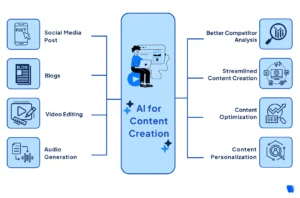
AI content creation goes far beyond just generating text — it now covers almost every form of digital content used in marketing. From written copy to visuals and videos, artificial intelligence is transforming how brands communicate, engage, and convert audiences.
AI-Generated Writing
- Blogs
- Articles
- Website content
- Landing pages
- Social media posts
- Email newsletters
AI-Designed Visual Content
- Graphics & banners
- Thumbnails
- Infographics
- Logos
- Social media creatives
AI-Video Content
- Video scripts
- AI voice-over narration
- Auto-editing tools
- Animated video avatars
AI-SEO Content
- Keyword research
- Title & meta tag suggestions
- SEO-optimized content briefs
- SERP analysis
AI-Audio & Voice
- Podcast scripts
- Voiceover content
- AI dubbing
AI has moved beyond text — it now creates multi-format media for every marketing need.
Popular AI Content Creation Tools

Here are top tools used by marketers & businesses:
AI Writing Tools
| Tool | Best Use |
| ChatGPT | General writing & marketing content |
| Jasper AI | Branded content & long-form SEO articles |
| Copy.ai | Social posts & copywriting |
| Writesonic | Blogging & website content |
AI Image & Design Tools
| Tool | Best Use |
| Canva AI | Graphics, social media creatives |
| Midjourney | Hyper-realistic and artistic images |
| DALL-E | Creative visual assets & concept art |
| Adobe Firefly | Professional image design & editing |
AI Video Tools
| Tool | Best Use |
| InVideo | Animated marketing videos |
| Pictory | Converting scripts to videos |
| Descript | Voice clone & studio-level editing |
| Synthesia | AI avatars for explainer videos |
AI Voice & Audio
- ElevenLabs
- Murf AI
- Speechelo
With the right tools, anyone can create content that looks professional and polished — even without technical skills.
How To Use AI for Content Creation (Step-by-Step)

Short, practical guide you can use right away — for blog posts, social posts, ads, videos, images, and more.
1. Define Your Content Goal
- Education?
- Lead generation?
- Brand awareness?
- Sales?
2. Research & Plan
Use AI to gather:
- Topic ideas
- Trending keywords
- Search intent analysis
3. Create Detailed Prompts
Clear prompts produce better content.
Example prompt:
“Write a 150-word social media caption about AI content creation trends for small businesses, friendly tone, include hashtags.”
4. Review & Edit
AI gives structure — you add creativity & human insight.
5. Optimize for SEO
Ask AI to:
- Insert keywords naturally
- Add internal/external links
- Create meta title & description
- Improve readability
6. Publish & Repurpose
Turn one AI-generated blog into:
- Instagram carousel
- YouTube script
- Email newsletter
- LinkedIn post
AI = Content multiplication power
AI Content Creation Best Practices
AI content creation can be a game-changer — but only when used strategically. To ensure your AI-generated content is high-quality, authentic, and results-driven, follow these best practices:
1. Start with a Clear Purpose
Before you prompt an AI tool, define your content goal — is it to educate, engage, or convert? A clear objective ensures the output aligns with your marketing strategy.
2. Always Provide a Detailed Prompt
The quality of AI content depends on how specific your prompt is. Include the target audience, tone, style, keywords, format, and examples of the voice you want.
Example: “Write a friendly 300-word LinkedIn post about how small businesses can use AI tools to save time.”
3. Maintain Human Oversight
AI can create fast, but humans add meaning. Always review, edit, and fact-check to ensure your brand voice, tone, and accuracy remain intact.
4. Prioritize Authenticity and Originality
Avoid publishing AI content as-is. Add real-world examples, brand stories, and personal insights — these make your content feel authentic and trustworthy.
5. Blend Creativity with Data
Use AI analytics and SEO insights to guide your topics and keywords, but rely on human creativity for storytelling and emotional connection.
6. Optimize for SEO Naturally
AI can suggest keywords, headings, and structure — but avoid over-optimization. Keep your writing reader-friendly, not robotic.
7. Stay Transparent and Ethical
If your content heavily uses AI, be transparent about it when appropriate. Avoid plagiarism, bias, or misinformation, and respect copyright laws.
8. Experiment and Iterate
Treat AI as a creative partner. Test different prompts, tones, and formats. Analyze what performs best and refine your workflow continuously.
9. Use AI for Support, Not Replacement
AI should enhance your team’s productivity — not replace human creativity. The best results come from collaboration between AI tools and skilled creators.
10. Keep Learning and Adapting
AI technology evolves fast. Stay updated with the latest tools, algorithms, and content trends to keep your strategy effective in the ever-changing digital space.
Use AI for:
- Brainstorming ideas
- Content outlines
- First drafts
- Editing & rewriting
- SEO improvements
- Quick social content
Add Human Touch:
- Personal experiences
- Tone & storytelling
- Emotion & empathy
- Creativity & unique value
- Industry expertise
Avoid Relying 100% on AI
AI is powerful — but your voice & judgment make content memorable.
Common Mistakes to Avoid
While AI tools make content creation faster and smarter, it’s easy to make mistakes that can hurt quality, credibility, and performance.
| Mistake | Result |
| Relying fully on AI | Generic content |
| No fact-checking | Incorrect information |
| Not adding personal tone | Robotic content |
| Poor prompting | Weak output |
| Ignoring SEO | Low search ranking |
AI is a tool — your strategy drives success.
Ethical & SEO Concerns in AI Content Creation

AI content creation offers speed and scale, but it also raises important ethical and SEO challenges that creators can’t ignore. To maintain trust and visibility, it’s essential to balance automation with responsibility.
1. Authenticity and Transparency
AI-generated content should never mislead readers into thinking it’s entirely human-written. Be transparent about using AI tools when appropriate, especially for journalistic or educational content. Transparency builds credibility and prevents reputational risks.
2. Plagiarism and Copyright Issues
Some AI tools may unintentionally reproduce parts of existing content. Always run plagiarism checks and ensure that your AI outputs are rewritten, verified, and free from copyrighted material.
3. Bias and Fairness
AI systems learn from existing online data, which can include bias. This means outputs might unintentionally reinforce stereotypes or misinformation. Always review your content with a critical eye to maintain fairness and inclusivity.
4. Data Privacy Concerns
Avoid entering confidential or sensitive information into AI tools. Understand how your chosen platform handles data storage and privacy to ensure compliance with global data protection standards.
5. Misinformation and Accuracy
AI models can occasionally produce information that sounds accurate but is actually incorrect or misleading.
6. Over-Optimization for SEO
AI tools can suggest keywords and meta descriptions, but excessive keyword use or repetitive phrasing can lead to over-optimization — hurting search rankings. Focus on natural language and user intent over keyword density.
7. Lack of Original Value
Search engines, especially Google, now prioritize E-E-A-T (Experience, Expertise, Authoritativeness, Trustworthiness). Purely AI-written content without human insights risks being downgraded in rankings. Always enrich AI drafts with personal experience and expert input.
8. Duplicate or Low-Quality Content
If multiple users generate similar AI-based content, duplication becomes a serious SEO problem. Customize outputs with unique data, stories, and perspectives to ensure originality.
9. Manipulative or Deceptive Use
Using AI to create fake reviews, misleading claims, or clickbait violates both ethical standards and search engine policies. Such practices can lead to severe penalties or bans.
10. Balancing AI with Human Creativity
Ethical AI content creation means using technology responsibly — to enhance, not replace, human creativity. The best-performing content blends machine efficiency with authentic human storytelling.
AI content is allowed in SEO — if it’s useful, original, and helpful.
But be mindful of:
Ethical Guidelines
- Do not plagiarize
- Be transparent when needed
- Verify facts
- Avoid bias & harmful content
SEO Guidelines
- Avoid AI-generated spam
- Keep information accurate
- Prioritize user value over shortcuts
Search engines reward quality, authenticity, and trust.
Future Trends in AI Content Creation

As AI continues to evolve, its role in content creation is becoming even more dynamic and intelligent. The next few years will bring innovations that make AI not just a creative assistant — but a true strategic partner in digital storytelling.
AI will continue to evolve. Key trends to watch:
Hyper-personalized content
Custom content based on behavior & preferences.
AI-generated video dominance
AI video creation will become mainstream.
Human + AI hybrid creativity
Writers who understand AI will outshine those who don’t.
Predictive content
AI will tell you which topics will trend.
Multi-language instant content
Global content creation becomes effortless.
AI is not replacing humans — it’s empowering them to create more, faster, and smarter.
Conclusion
AI content creation is not just a passing trend — it’s the future of digital marketing and content production. As technology continues to evolve, businesses that embrace AI will stay ahead of the competition, while those that resist it risk falling behind.
Whether you’re a marketer, business owner, content creator, or entrepreneur, using AI tools can completely transform how you plan, produce, and optimize content. When used strategically, AI empowers you to:
Save time by automating repetitive writing, design, and editing tasks.
Reduce costs by minimizing the need for large creative teams or outsourcing.
Improve quality with data-driven insights, personalization, and real-time optimization.
Scale faster by producing consistent, high-impact content across multiple platforms.
Increase conversions through targeted messaging that resonates with the right audience.
But the real power of AI lies in how you use it. The most successful creators treat AI as a creative partner — combining machine efficiency with human emotion, storytelling, and strategy.
As we move into the future, the brands that will stand out are those that blend artificial intelligence with authentic human creativity — creating content that’s not only smarter but also more meaningful and engaging.
Author : Shilpa VK
